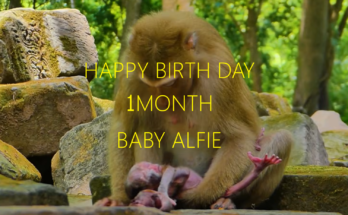
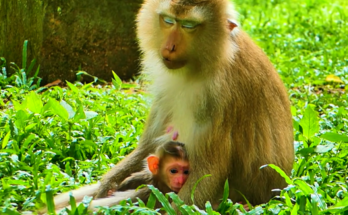
In a quiet corner of the wild, where the trees sway gently and the morning mist hangs low, a heartbreaking yet powerful moment unfolded that has captured the attention of animal lovers around the world.
An aging mother monkey named Rozy, frail but determined, was seen giving birth to a fragile newborn deep within the forest canopy. It was a moment that should have been filled with warmth, care, and the quiet bond between mother and infant. But life in the wild is often far more complicated than it appears.
Rozy, already weakened by age and exhaustion, struggled through the difficult birth. Her small body trembled as she held her newborn close for the very first time. The baby, tiny and delicate, let out soft cries—signaling its need for warmth and, most importantly, milk. For a brief moment, it seemed as though nature itself had paused to witness the fragile beginning of a new life.
But what followed left viewers deeply emotional.
Despite the instinctive bond between mother and child, Rozy appeared overwhelmed. Her body, no longer strong enough to sustain the demands of nursing, showed signs of distress. The newborn continued to nuzzle in search of nourishment, but the aging mother seemed unable to provide the milk the baby desperately needed.
As hours passed, an unsettling distance grew between them. Rozy, exhausted and visibly weakened, began to withdraw. In a heartbreaking turn, she moved slightly away, leaving the fragile newborn alone on the soft forest floor.
For many observers, this moment was almost too painful to watch. The image of a tiny infant monkey, still so vulnerable and dependent, left without the comfort and care it so urgently needed, struck a deep emotional chord. It wasn’t rejection born of cruelty, but rather the harsh reality of survival in the wild—where even a mother’s love can be challenged by age, weakness, and instinctual limitations.
Wildlife experts often explain that such behavior, while difficult to witness, is sometimes a reflection of natural survival pressures. In the animal kingdom, especially among primates, mothers under severe physical strain may struggle to meet the demands of newborn care. When resources are limited or the mother’s health declines, instinct can force heartbreaking decisions.
Still, the emotional impact remains undeniable.
Rozy’s story has resonated deeply with viewers across the United States and beyond. Many describe feeling both sorrow and compassion—not only for the fragile newborn fighting for survival, but also for the exhausted mother who appears trapped between instinct and limitation.
As the scene continues to circulate, it serves as a powerful reminder of the raw reality of life in the wild. There is beauty, but also struggle. There is connection, but also loss. And sometimes, even the strongest bonds are tested by forces beyond control.
For Rozy and her fragile newborn, the future remains uncertain. Whether the baby survives will depend on circumstances far beyond what any mother—or observer—can control.
And yet, in this quiet and heartbreaking moment, many are reminded of something deeply human: the fragile balance between life, survival, and the limits of even a mother’s love in the natural world.