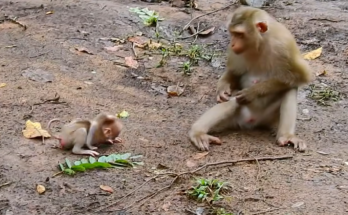
The tiny baby monkey had been wandering alone for what felt like forever.
Her small cries echoed through the forest as she searched desperately for the one face she knew best—her mother. Every rustling leaf made her stop. Every distant movement filled her with hope.
Then, she saw a familiar figure.
A female monkey was sitting quietly on a low branch, grooming herself. Without hesitation, the frightened infant raced toward her. Her tiny arms reached out, trembling with excitement. Surely, after hours of fear and loneliness, she had finally found her mother.
But she was wrong.
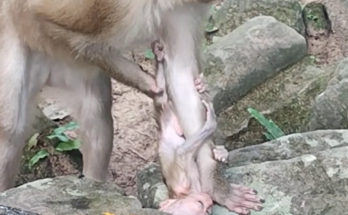
The adult monkey turned suddenly, startled by the unexpected visitor. Instead of welcoming the little one, she pushed her away with surprising force. The baby lost her balance, tumbling onto the forest floor.
Confused, she stood back up.
She didn’t understand.
She tried again.
With innocent determination, the tiny monkey climbed back toward the female, crying softly as if pleading to be held. Once more, she reached out with hopeful eyes.
Again, she was rejected.
This time, the adult monkey chased her away more aggressively, forcing the frightened infant to run for safety. She hid behind a fallen tree, peeking out with wide, tearful eyes.
To human observers, the scene was heartbreaking.
The baby had mistaken another monkey for the mother she had lost.
For young primates, the bond with their mother is everything. Mothers provide warmth, food, protection, and reassurance. Without that familiar presence, orphaned infants often search for any adult that resembles the one they remember.
Unfortunately, not every adult monkey accepts a baby that isn’t their own.
The little monkey spent the next several hours alone, cautiously watching nearby monkey groups. Each time she heard soft calls or saw a female carrying an infant, hope returned to her eyes. She would slowly approach, only to stop when the adults warned her away.
Her confidence faded.
She curled into a small ball beneath thick leaves as the afternoon sun disappeared behind the trees. Alone, frightened, and exhausted, she wrapped her tiny tail around herself for comfort.
Then something unexpected happened.
An older female monkey from a nearby troop noticed the lonely infant.
Unlike the others, she didn’t chase the baby away.
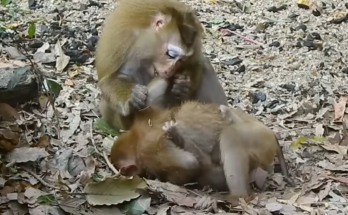
Instead, she sat quietly a short distance away, allowing the little monkey to approach at her own pace. There were no sudden movements. No loud threats. Just patience.
Slowly, the orphan crawled closer.
The older female sniffed the baby’s head and gently touched her shoulder.
For the first time that day, the frightened infant stopped crying.
While the older monkey was not her biological mother, her calm behavior gave the baby something she desperately needed—a moment of safety.
In many monkey species, adoption is uncommon but not impossible. Some females, particularly experienced or related individuals, may tolerate or even care for orphaned infants under certain circumstances. Every troop and every situation is different, and survival is never guaranteed.
As evening settled over the forest, the tiny monkey remained close to the older female, carefully following her from branch to branch. It wasn’t the reunion she had dreamed of, but it was a chance—a small spark of hope after a day filled with fear.
Her heartbreaking mistake had nearly left her completely alone.
Yet kindness, however unexpected, reminded everyone watching that compassion can appear in the most unlikely moments.
The little monkey still had an uncertain journey ahead, but she no longer faced the darkness entirely by herself.
Sometimes, healing doesn’t begin with finding the one you lost.
Sometimes, it begins with someone willing to stop… and give you another chance.
Disclaimer: This is a fictional, emotionally inspired story created for storytelling purposes. Animal behavior varies widely in nature, and this narrative should not be interpreted as a description of a specific real-life event.