
Baby Conga in Distress as Mother Gonda Reacts
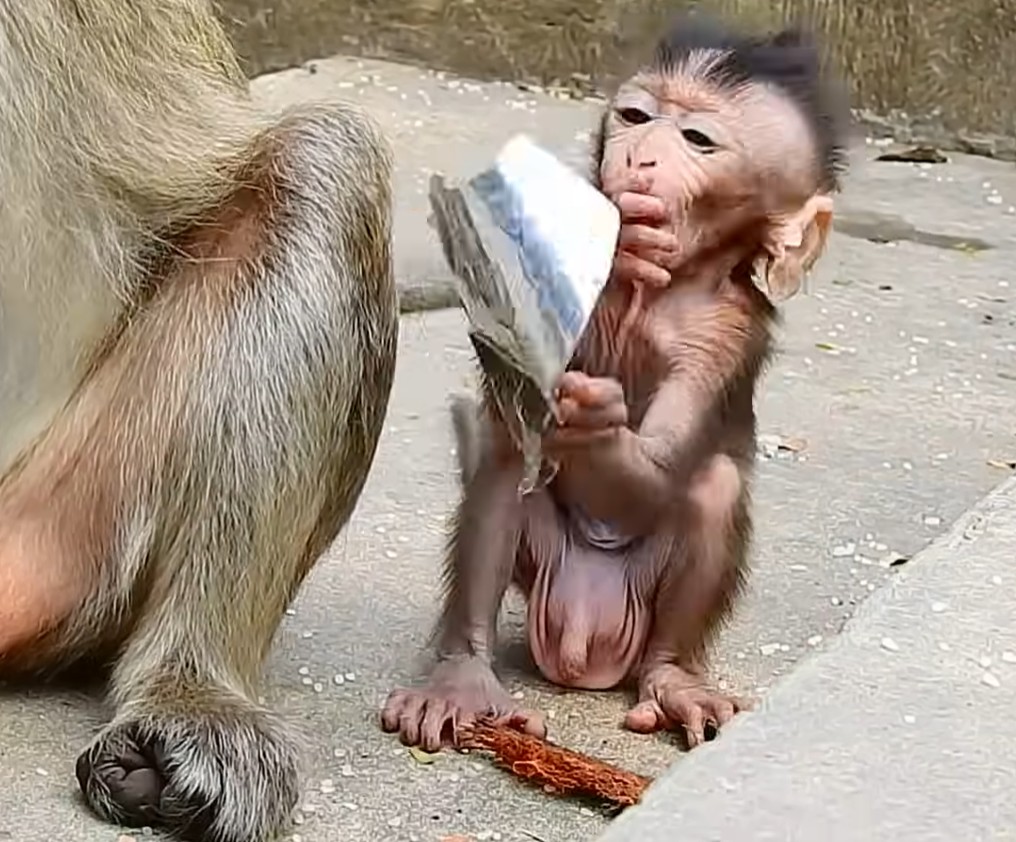
The forest was unusually quiet that morning, as if even the wind had paused to listen. High in the tangled canopy, a young mother monkey named Gonda clutched a branch, her eyes darting anxiously in every direction. Something wasn’t right—and she knew it.
Just hours earlier, everything had felt normal. The sun filtered gently through the leaves, and her tiny baby, Conga, had been curled safely against her chest. But now, confusion clouded Gonda’s instincts. She shifted nervously, her grip tightening and loosening as if she couldn’t decide what to do next.
Below her, the world moved as always—birds called, leaves rustled—but for Gonda, time seemed to slow.
A faint sound broke the silence.
Soft. Fragile.
Conga.
The tiny baby let out a quiet cry, barely more than a whisper. It wasn’t loud or demanding—it was the kind of cry that carried uncertainty, a gentle plea for warmth, for reassurance, for love.
Gonda froze.
She looked down at Conga, her expression unreadable. For a moment, she seemed unsure if she recognized the small life clinging to her. Her body shifted awkwardly, almost as if she were trying to remember something deeply buried inside her instincts.
Conga cried again, slightly louder this time.
The sound tugged at something deep within Gonda. Her breathing slowed. Her eyes softened. But still, hesitation lingered.
It was a heartbreaking moment—one that spoke not of rejection, but of confusion. Gonda wasn’t cruel. She wasn’t uncaring. She was overwhelmed.
Around them, a few other monkeys watched from a distance. They didn’t intervene. In the wild, moments like these unfold quietly, guided by instinct and time.
Conga’s tiny fingers reached out, grasping weakly at Gonda’s fur. The baby’s movements were slow, uncoordinated—but determined. It was a silent message: I need you.
And something changed.
Gonda’s posture shifted. Her tense shoulders relaxed just slightly. She lowered her head, bringing her face closer to Conga. For the first time since the confusion began, she truly looked—really looked—at her baby.
Another soft cry.
This time, Gonda responded.
It wasn’t dramatic. There was no sudden rush or perfect instinct. Instead, it was small… careful. She adjusted her hold, pulling Conga closer to her chest. Her arms wrapped around the tiny body, uncertain but protective.
Conga immediately quieted.
The change was almost magical.
The fragile cries faded into soft breathing as the baby settled into the warmth of its mother. Gonda remained still, as if afraid to break the moment. Her eyes stayed fixed on Conga, studying every tiny movement, every breath.
Minutes passed.
Then something even more powerful happened—Gonda gently nuzzled her baby.
It was subtle, almost hesitant, but it spoke volumes. That simple motion carried reassurance, connection, and the beginning of understanding.
The confusion hadn’t completely disappeared. Gonda was still learning, still adjusting. But the bond was there, growing stronger with every passing second.
Conga, now calm, rested peacefully, comforted by the closeness it had been searching for all along.
In that quiet corner of the forest, a powerful story unfolded—not of perfection, but of resilience. A mother finding her way. A baby trusting without hesitation. And a fragile connection slowly turning into something unbreakable.
Moments like these remind us that love isn’t always immediate or easy. Sometimes, it takes patience. Sometimes, it takes time. But even in uncertainty, the smallest gestures—a gentle hold, a soft nuzzle—can change everything.
And on that quiet morning, as the forest slowly came back to life, Gonda held Conga just a little tighter.
You may also like

Mother Monkey Libby Gently Pulls Baby Rainbow’s Ears
Sometimes, the sweetest moments in a monkey family happen during the simplest everyday interactions. Mother monkey Libby and her little…

Mom Libby Welcomes a Visitor to Meet Lily, Leo and Rainbow
Something unexpected happened in Libby’s little monkey family when a new visitor arrived, creating a heartwarming moment that made everyone…
Mom Libby Teaches Baby Leo a Lesson After a Dusty Adventure
Every little monkey has a curious side, and baby Leo is no exception! Under the watchful eyes of his loving…