
An Elderly Mother Monkey Gently Nurses Her Baby
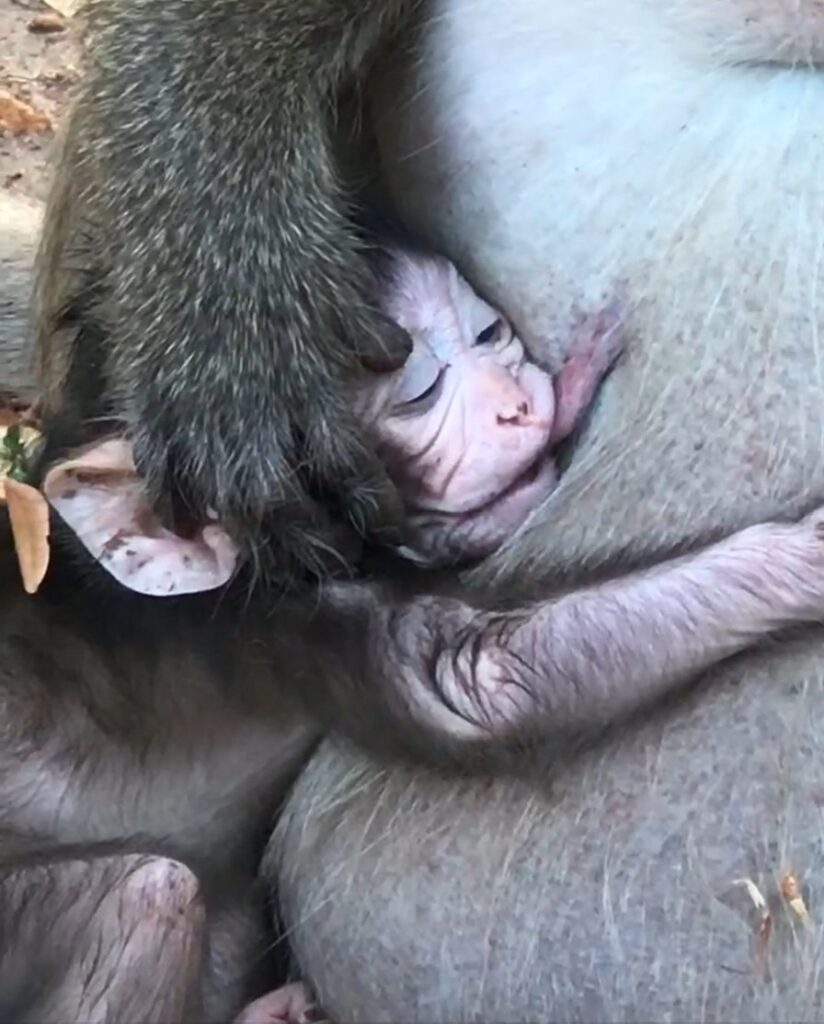
In a quiet corner of the forest, beneath a canopy of gently swaying leaves, a touching scene unfolds between an old mother monkey and her tiny baby. Time has etched its marks on the mother—her movements are slower, her fur no longer as glossy as it once was—but her eyes still shine with warmth, wisdom, and deep affection. Cradled close to her chest, her baby clings tightly, seeking comfort, safety, and nourishment.
The baby monkey is small and fragile, its fingers barely able to grasp the thick fur of its mother. Its eyes, wide with curiosity, occasionally glance around the world it has just begun to explore. But no matter how fascinating the surroundings may be, it always returns to the same place—its mother’s embrace. There, it finds everything it needs: protection, warmth, and most importantly, milk that sustains its early life.
The old mother gently adjusts her position, making sure her baby is comfortable. With practiced care, she allows the baby to feed, her body providing the nourishment essential for the baby’s growth. Though she may be aging, her ability to care remains unwavering. Each moment of feeding is more than just a physical act—it is a quiet blessing, a transfer of strength, life, and love from one generation to the next.
There is something deeply moving about the patience she shows. She does not rush or pull away. Instead, she sits calmly, occasionally grooming the baby with soft, deliberate motions. This grooming is not only about cleanliness; it is a bonding ritual, a way of reassuring the baby that it is safe and cherished. The baby, in return, presses closer, completely trusting in the presence of its mother.
Nature can often be harsh, and survival is never guaranteed. Yet, in this tender moment, the forest feels like a place of peace. The old mother monkey, despite her age, gives everything she has to ensure her baby has a strong start in life. Her milk becomes more than nourishment—it symbolizes hope, resilience, and continuity.
Observers who witness such a scene often feel a sense of awe. It reminds them that love and care are not limited by age or strength. Even in the later stages of life, the mother’s instinct to nurture remains powerful. Her actions speak of experience, of lessons learned over years, and of a deep understanding of what her baby needs to survive and thrive.
As the baby finishes feeding, it looks up briefly, its tiny face relaxed and content. The mother pulls it closer, wrapping her arms around it as if shielding it from the world. In that simple embrace lies a profound message: growth is not just about getting bigger or stronger—it is about being supported, protected, and loved.
This heartwarming scene captures the essence of motherhood in its purest form. It is a quiet, powerful reminder that even in the wild, compassion and care are at the center of life’s most important moments.
You may also like
Baby Monkey Bim Bim Visits the Pool and Opens Surprise Eggs
A popular YouTube clip shows baby monkey Bim Bim at a pool with ducklings and toy trucks. Here's what the…

A Two-Week-Old Macaque Learns to Move on His Own
A two-week-old macaque wobbles across dirt and leaf litter, pausing on unsteady legs while his mother watches nearby — early…
A Forest Troop Gathers Around a Fallen Baby Macaque
A quiet day of feeding turns somber as a macaque troop gathers in the forest around a baby that did…