
Why a 2-Year-Old Monkey Still Clings to Its Mother
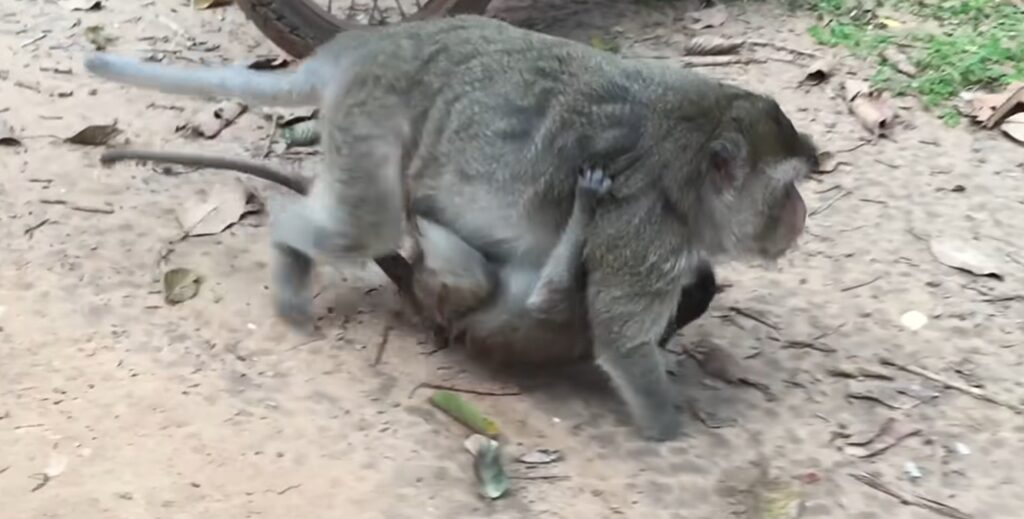
At an age when most young monkeys have already begun exploring the world independently, this particular juvenile remains unusually attached to its mother. Observers expected a gradual transition toward independence, yet the bond has only intensified over time. The behavior has sparked debates among primatologists, psychologists, and conservationists who are trying to understand what might be driving this prolonged dependence.
In many monkey species, early separation from the mother is a critical milestone. It allows young animals to develop social skills, learn to forage, and establish their place within a group. By the age of two, most individuals are already interacting with peers more than relying on maternal contact. That is why this case stands out so sharply, prompting researchers to reconsider assumptions about developmental timelines.
One possible explanation involves environmental stress. If the monkey’s habitat has experienced disruptions such as food scarcity, human interference, or predator pressure, the infant may feel less secure venturing away. Clinging could be a coping mechanism, reinforcing a sense of safety in an unpredictable environment. Studies have shown that animals under stress often display regressive behaviors, reverting to earlier stages of dependence.
Another theory centers on the mother herself. If she exhibits unusually attentive or protective behavior, she may inadvertently discourage independence. Constant grooming, carrying, or responding immediately to distress signals can reinforce the young monkey’s reliance. In this dynamic, the attachment is not solely driven by the infant, but also shaped by maternal patterns that differ from the norm.
There is also the possibility of individual temperament. Just as humans vary in personality, animals can differ in boldness, curiosity, and resilience. This monkey may simply have a more cautious disposition, preferring familiarity over risk. If so, its behavior challenges the idea that development follows a rigid, uniform path for all individuals within a species.
The implications extend beyond a single case. Understanding why this young monkey behaves differently could reshape how scientists interpret social bonds in primates. It may reveal that flexibility in development is more common than previously thought, or that environmental pressures can significantly alter expected milestones.
For conservationists, such insights are particularly valuable. If prolonged dependence is linked to habitat disturbance, it could serve as an early warning sign of ecological imbalance. Monitoring similar behaviors in other populations might help identify areas where intervention is needed before conditions worsen.
Ultimately, the image of a two-year-old monkey clinging tightly to its mother is more than a touching moment; it is a puzzle that invites deeper inquiry. By studying such anomalies, experts can gain a richer understanding of the complex interplay between biology, environment, and behavior. In doing so, they move closer to uncovering the subtle forces that shape life in the animal kingdom, reminding us that even well-established patterns can still hold surprising exceptions worth exploring with curiosity and care.
As research continues, scientists are likely to employ long-term observation, behavioral tracking, and even hormonal analysis to uncover deeper explanations. Each new finding adds another layer to the story, highlighting how much remains unknown about animal development. Cases like this encourage humility in science, reminding experts that nature often resists simple explanations and demands careful, open-minded investigation over time and across contexts, ensuring that conclusions are grounded in evidence rather than
You may also like
Baby Monkey Bim Bim Visits the Pool and Opens Surprise Eggs
A popular YouTube clip shows baby monkey Bim Bim at a pool with ducklings and toy trucks. Here's what the…

A Two-Week-Old Macaque Learns to Move on His Own
A two-week-old macaque wobbles across dirt and leaf litter, pausing on unsteady legs while his mother watches nearby — early…
A Forest Troop Gathers Around a Fallen Baby Macaque
A quiet day of feeding turns somber as a macaque troop gathers in the forest around a baby that did…