
Mother Monkey Guards Her Baby From a Rival Male
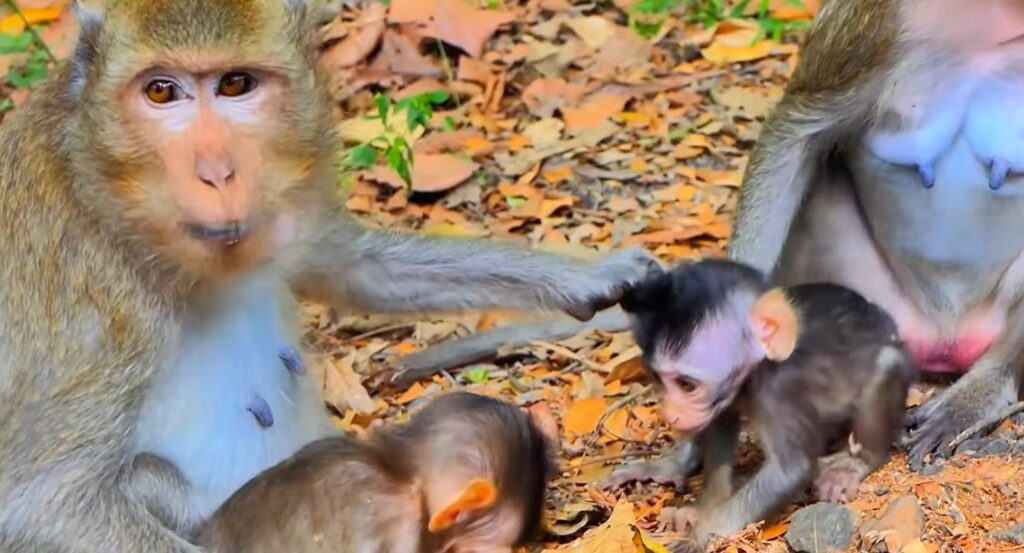
High in the tangled canopy, where the sunlight breaks into trembling fragments across broad green leaves, a mother monkey clutches her baby with a grip that speaks louder than any cry. Her body is tense, every muscle alert, every movement calculated. Fear has become her constant companion. It lingers in the way her eyes dart between branches, in the stiffness of her posture, in the urgency with which she pulls her infant closer whenever a shadow shifts nearby.
Her baby is small—so small it seems impossible that something so fragile could survive in a world so relentlessly harsh. Its fingers curl instinctively into her fur, unaware of the danger that hums quietly through the forest. The infant trusts completely, resting its head against her chest, listening to the rhythm of her heartbeat. But that heartbeat is faster than it should be, driven by a dread the baby cannot yet understand.
The threat is not distant. Somewhere within the same territory, a rival male moves through the trees with purpose. He is powerful, unpredictable, and driven by instinct. For him, the presence of an infant that is not his own represents an obstacle—a barrier to passing on his own genes. The brutal logic of survival in the wild dictates actions that, to human eyes, seem merciless. To the mother, it means one thing: her baby is in danger.
She has seen it before. She remembers the sudden chaos, the sharp cries, the desperate chases that ended in silence. Those memories are carved deeply into her mind, shaping her every decision. Now, she refuses to stray far from safe routes. She chooses higher branches, narrower paths where a larger male might struggle to follow. Every rustle of leaves makes her freeze, listening, calculating whether to flee or remain still.
Other monkeys move through the trees, some indifferent, others vaguely aware of the tension. Social bonds exist, but they are not enough to guarantee safety. No one can fully shield her from the threat she fears most. This is a burden she must carry alone.
When she feeds, she does so quickly, never letting her guard down. Even as she reaches for fruit, one arm remains firmly wrapped around her baby. Hunger competes with vigilance, but vigilance always wins. Survival demands sacrifice, and she accepts it without hesitation.
At times, the forest seems almost peaceful. A breeze stirs the leaves, birds call in the distance, and for a fleeting moment, her grip loosens. She grooms her baby gently, her touch soft, her expression briefly calm. In these rare seconds, she is not driven by fear but by love—a quiet, powerful force that fuels her determination to keep going.
But peace never lasts long. A distant branch snaps, and instantly she is alert again, body coiled, ready to move. She pulls her infant close, pressing it against her as if she could shield it from the entire world.
In this constant tension between fear and devotion, the mother endures. Every leap, every glance, every breath is guided by one purpose: to protect the life she carries. The forest is unforgiving, and danger may strike without warning, but she will not yield easily. Her courage is not loud or heroic in the traditional sense. It is quiet, relentless, and deeply rooted in instinct.
And as long as she holds her baby close, she will keep fighting.
You may also like
Baby Monkey Bim Bim Visits the Pool and Opens Surprise Eggs
A popular YouTube clip shows baby monkey Bim Bim at a pool with ducklings and toy trucks. Here's what the…

A Two-Week-Old Macaque Learns to Move on His Own
A two-week-old macaque wobbles across dirt and leaf litter, pausing on unsteady legs while his mother watches nearby — early…
A Forest Troop Gathers Around a Fallen Baby Macaque
A quiet day of feeding turns somber as a macaque troop gathers in the forest around a baby that did…