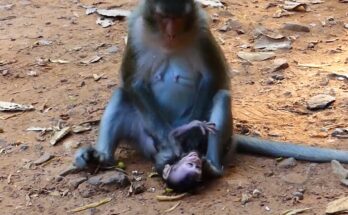
Langur monkeys mourn lifeless fake monkey, displaying powerful social bonds and touching collective sadness today. In a surprising and deeply emotional scene, a troop of langur monkeys gathered around what they believed to be a fallen infant. The “body” was actually a realistic model placed by researchers to study their reactions, yet the monkeys’ responses revealed something profoundly meaningful about their emotional depth and social connections.
As soon as the fake infant was discovered, several adult females immediately approached it, touching and gently lifting it as if checking for signs of life. Their soft vocalizations echoed through the branches, resembling the same calls used when real infants are in distress. Mothers hugged the model close, rocking it tenderly, while young juveniles sat quietly nearby, sensing the seriousness of the moment.
What made this scene even more moving was the collective behavior that followed. The troop formed a loose circle around the “infant,” remaining unusually calm and silent. Dominant males, who usually maintain distance during infant-focused moments, stayed close and watched protectively. Every gesture suggested an understanding—perhaps not of death as humans perceive it, but of loss, vulnerability, and the need for unity.
Researchers observing the event were struck by the intensity of the troop’s reactions. The langurs’ behavior hints at complex emotional capacities, demonstrating that their social bonds extend far beyond routine grooming or cooperative defense. They respond to perceived tragedy with empathy-like behaviors, showing that grief, or something close to it, may not be unique to humans.
Moments like this remind us of the deep emotional lives that animals carry quietly within their forests. Even when the “infant” is not real, the feelings it evokes are. This powerful display from the langur troop highlights their sensitivity, intelligence, and the profound social ties that hold their families together.